
Every five years, IBEW Local 11 sits down with contractors to negotiate the terms that shape daily life on the job — wages, benefits, safety protections, and how disputes get resolved. This year's negotiations for the Inside Wiremen Agreement, covering July 1, 2026 through June 30, 2031, are done, and now it's in the membership's hands.
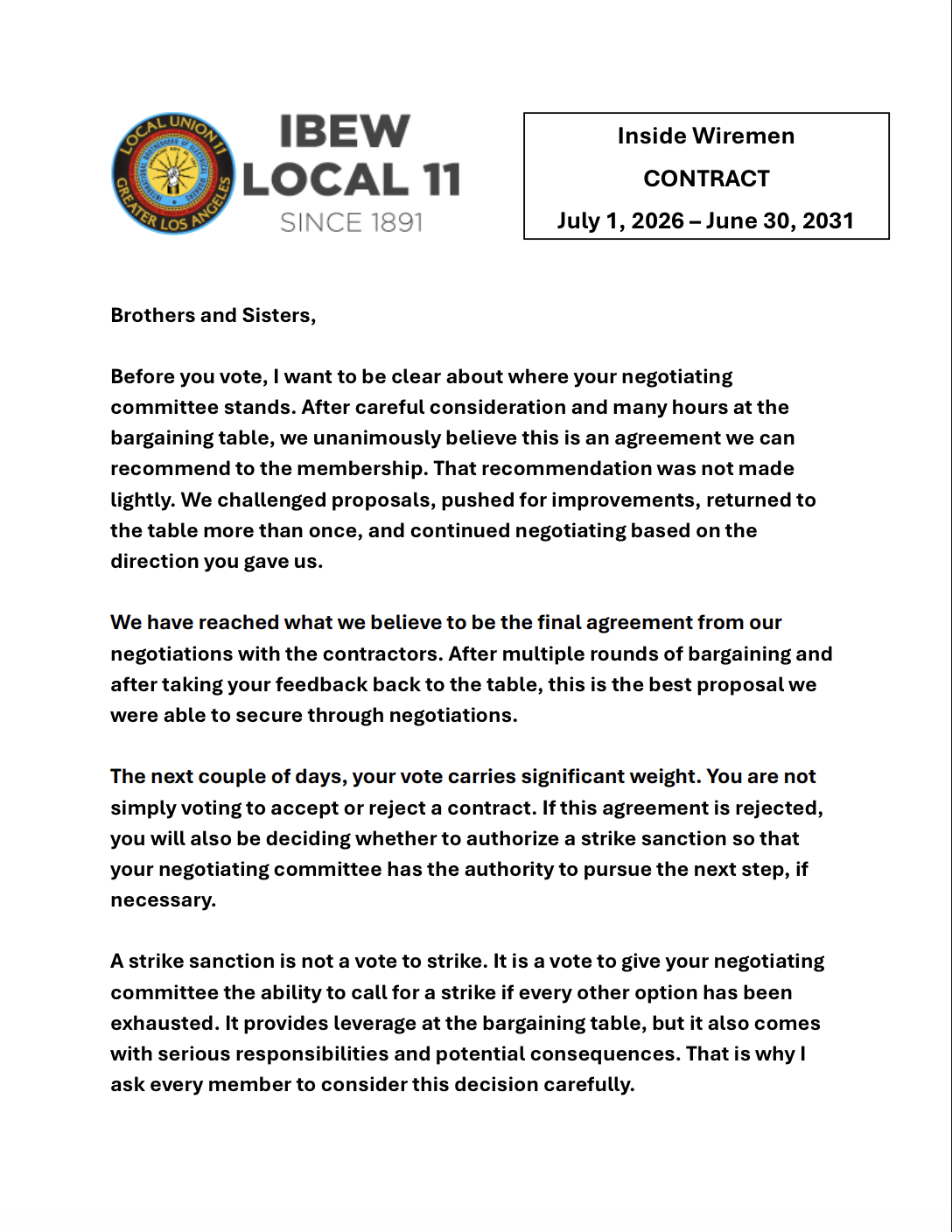
Business Manager Robert Corona and the negotiating committee are recommending this agreement unanimously. That doesn't mean it happened easily — the committee went back to the table multiple times, brought member feedback into the room, and pushed for changes based on the direction the membership gave them.
Before you vote, here's a look at what's actually in the deal.
The Vote Isn't Just Yes or No
This vote carries two decisions. First, whether to accept the agreement as negotiated. Second — and only if the agreement is rejected — whether to authorize a strike sanction.
A strike sanction is not a vote to strike immediately. It gives the negotiating committee the authority to call a strike if every other avenue has been exhausted. It's a source of leverage, but it comes with real responsibilities and consequences, which is why the committee is asking members to weigh this decision seriously.
Wages: $22.50 an Hour Over Five Years
The agreement includes a total wage package increase of $22.50/hour, phased across ten increases from July 27, 2026 through January 27, 2031. The first increase — $2.20/hour effective 7/27/2026 — is broken down as $2.00 to the paycheck, $0.10 to health, and $0.10 to training. Later increases will be allocated by the allocation committee, subject to membership approval.
Specialty classifications also see a bump: cable splicing, welding, instrumentation, and NETA testing rates increase from 1.05x to 1.075x the journeyman rate.
A New Benefit: Employer-Funded PTO
This is one of the biggest changes in the agreement. Starting July 27, 2026, contractors will contribute a percentage of gross wages into a dedicated PTO fund — separate from and in addition to wage increases. That percentage grows over the life of the contract:
- 7/27/2026 – 0.25%
- 2/01/2027 – 0.50%
- 7/26/2027 – 0.75%
- 1/31/2028 – 1.00%
- 7/31/2028 – 1.25%
- 1/29/2029 – 1.50%
- 7/30/2029 – 1.75%
- 1/28/2030 – 2.00%
By the fourth year of the contract, this builds to the equivalent of five days' wages in PTO.
How it works, in plain terms:
- It doesn't come out of your wages — it's funded separately by the contractor.
- It's deposited into an account in your name at the credit union, similar to the vacation fund, but without restrictions or withdrawal fees.
- You start earning it from your first hour worked — no waiting period.
- No doctor's note required to access it.
- It stays with you if you change contractors.
Holiday List Update
Cesar Chavez Day has been removed from the holiday list and replaced with Presidents Day.
Safety and Reimbursement Improvements
Several changes aim to put more money back in members' pockets for costs tied directly to the job:
Boot reimbursement nearly doubled — from $175 to $300 for safety footwear required by the customer as a condition of the job site.
Tool theft reimbursement, faster — if tools are stolen from a secured, employer-provided location through no fault of the employee, reimbursement is now funded through the LMCC (funded two-thirds by NECA, one-third by IBEW) and remitted directly to the contractor, speeding up the process for members.
Personal cell phone use compensated — if an employer requires use of a personal device for work, they must either provide a company-issued device at no cost or pay a $7.50/week reimbursement. Employers cannot require GPS or location tracking on personal devices, and members can't be disciplined for declining to use a personal phone when no device or reimbursement has been provided.
New hazard pay for arc-flash work — members working on energized equipment requiring 40 cal or greater arc-flash protection will now receive a 10% premium above the applicable base rate while testing for absence of voltage. This doesn't apply once equipment is safely closed off. The committee noted this is a starting point — future negotiations could expand hazard pay to other high-risk conditions.
Show-up pay clarified — existing 2-hour show-up pay and 4-hour minimums remain unchanged, with added language ensuring employees working 4–6 hours are paid for 6, and those working 6–8 hours are paid for 8.
Apprentice Ratio Aligned with State Law
The apprentice-to-journeyman ratio has been updated to match California state law, allowing a 1:1 ratio starting with the second journeyman on a job. The committee's reasoning: non-union contractors already bid jobs using this ratio, and aligning with state law helps union contractors compete for prevailing wage work — which means more work for members.
Updated Grievance and Arbitration Procedures
A new Appendix 2 has been added addressing how certain disputes — including statutory wage-hour claims and discrimination claims — get resolved. Rather than going through the courts, these disputes will be handled through binding arbitration, with the union retaining sole authority to bring contractual grievances to arbitration. The agreement also includes a waiver of California's Private Attorneys General Act (PAGA) for covered employees, redirecting those claims into the arbitration process instead.
The committee's stated rationale: arbitration under a collective bargaining agreement tends to be faster and less costly than litigation, and this structure has been upheld by federal law for decades.
What Happens Next
This is the agreement your negotiating committee is bringing back to you — the strongest one they believe they could secure at the table. Now it's up to the membership to decide whether it meets expectations, or whether to move forward with strike authorization instead.
Whatever the outcome, the committee has said it will respect the will of the membership and move forward united.
Full contract language and the complete summary of changes are available for review below.